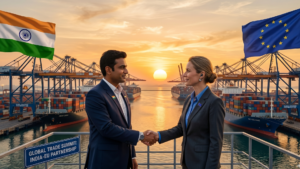
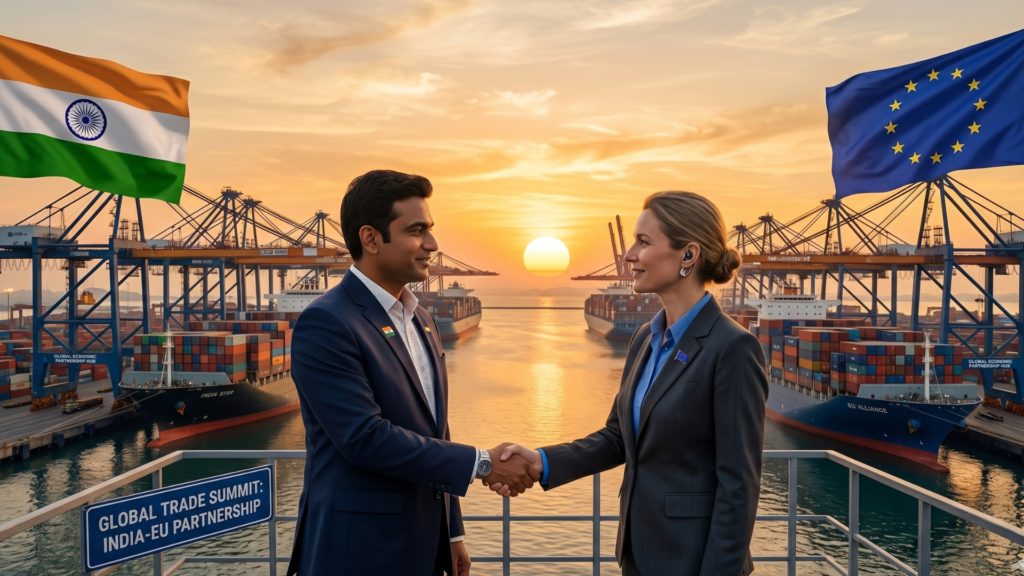
NEW DELHI — In what is widely being hailed as the most significant economic pact of the decade, the Republic of India and the European Union have officially concluded their historic Free Trade Agreement (FTA) in early 2026. Following negotiations that painfully spanned nearly two decades, characterized by complex geopolitical hurdles and domestic economic sensitivities, this monumental treaty has finally crossed the finish line.
Dubbed the “mother of all deals” by European Commission President Ursula von der Leyen, the agreement physically integrates a combined consumer base of over two billion people. Representing a staggering share of the global gross domestic product (GDP), the India-EU FTA is not merely a transactional trade document; it is a profound structural shift in the global trade architecture that promises to redefine international supply chains, investment flows, and strategic alliances for generations to come.
A Historic Milestone in Global Diplomacy
The formal announcement of the agreement took place at a highly publicized India-European Union summit held at Hyderabad House in New Delhi. The summit was attended by top leadership, including Indian Prime Minister Narendra Modi, European Commission President Ursula von der Leyen, and European Council President António Costa.
Prime Minister Modi underscored the immense scale of the pact, noting that it unlocks unprecedented opportunities for the 1.4 billion people of India and hundreds of millions of European citizens. For the European Union, securing market access in the world’s fastest-growing major economy represents a critical victory. As global trade alignments shift—driven heavily by tensions between the United States, China, and ongoing geopolitical fallout from the Russia-Ukraine conflict—Europe has actively sought to reduce its reliance on volatile markets. India, with its massive demographic dividend and rapidly expanding middle class, emerged as the perfect strategic partner.
Breaking Down the Tariff Reductions
At the core of the India-EU Free Trade Agreement is an aggressive and comprehensive framework for tariff elimination. According to the European Commission, the agreement will cut or completely eliminate tariffs on almost 97 percent of European exports to India. This sweeping reduction is projected to save European businesses up to €4 billion annually in export duties and is expected to double the volume of EU exports to India by the year 2032.
From the Indian perspective, the agreement provides preferential, zero-duty access to the lucrative European market for over 99 percent of its exports by value. For decades, Indian exporters have faced a competitive disadvantage in Europe compared to neighboring countries. This new tariff structure levels the playing field, allowing Indian goods to compete purely on quality, scale, and manufacturing efficiency.
Major Wins for the Textile, Apparel, and Leather Sectors
One of the most immediate beneficiaries of the FTA is India’s labor-intensive manufacturing sector, particularly textiles, apparel, leather, and footwear. Historically, Indian exporters in these categories faced EU tariffs ranging from 12% to 17%. This allowed competing nations like Bangladesh, Vietnam, and Pakistan—which enjoyed zero-duty access under various preferential trade schemes—to dominate the European retail market.
With the 2026 agreement eliminating these tariffs, Indian textile and leather manufacturers are experiencing a massive surge in European demand. Industry experts project that the removal of these financial barriers will result in billions of dollars in new export orders, subsequently creating millions of manufacturing jobs across the Indian subcontinent. The deal empowers Indian MSMEs (Micro, Small, and Medium Enterprises) to deeply integrate into European value chains, translating their inherent cost advantages into a sustained, long-term market presence.
The European Automotive and High-Tech Industries
The trade flow is highly reciprocal. For years, European automotive giants and machinery manufacturers have lobbied for better access to the Indian market, which has traditionally maintained notoriously high import tariffs to protect domestic industries. The 2026 FTA addresses this head-on.
The agreement outlines a phased reduction of Indian import tariffs on European automobiles, slashing them from a prohibitive 110 percent down to around 10 percent over a specified timeline. This is a massive victory for German, French, and Italian automakers, who can now market their premium and electric vehicles to India’s burgeoning upper-middle class at highly competitive prices.
Furthermore, the deal eliminates tariffs on most European exports of high-tech equipment, including optical, medical, surgical, and aerospace technology. Duties on European machinery (previously up to 44%), chemicals (22%), and pharmaceuticals (11%) are entirely wiped out. This influx of advanced European machinery and technology is expected to dramatically accelerate India’s own industrial modernization and technological capacity.
The Services Shift: IT, Consulting, and Financial Services
While the movement of physical goods dominates headlines, the true modern engine of this agreement lies in the services sector. The India-EU FTA includes robust, preferential market access commitments in over 140 services subsectors.
India, already a global powerhouse in IT and software development, will see its services exports to the EU skyrocket. The agreement covers critical areas such as business process outsourcing (BPO), telecommunications, and professional financial consulting. Prior to the full ratification of the deal, services trade between India and the EU had already touched €60 billion, and this figure is expected to multiply exponentially. By offering clear regulatory commitments, the FTA ensures market predictability for massive multinational tech firms and financial institutions operating across both regions.
Beyond Trade: Security, Defence, and Human Mobility
Recognizing that economic integration cannot thrive without shared security, the FTA was signed alongside a broader Security and Defence Partnership. Both regions have committed to enhancing cooperation in highly sensitive domains, including maritime security in the Indo-Pacific, joint counterterrorism initiatives, cyberdefense frameworks, and defense procurement.
Perhaps most significantly for the general public, the summit concluded with a landmark mobility and migration agreement. Recognizing Europe’s aging workforce and India’s massive surplus of highly educated youth, this migration pact establishes streamlined, legal pathways to the EU for Indian students, researchers, and skilled professionals. This ensures that European tech, medical, and engineering sectors will have reliable access to world-class talent, while providing Indian professionals with lucrative international career opportunities.
Navigating Shifting Global Supply Chains
The timing of the India-EU Trade Deal is no coincidence. In a post-pandemic world heavily focused on supply chain resilience, multinational corporations have aggressively pursued a “China Plus One” strategy to diversify their manufacturing bases. By establishing a transparent, predictable, and rules-based architecture, this FTA officially crowns India as the primary anchor for this global supply chain diversification.
The agreement also synergizes perfectly with massive infrastructure projects currently underway, such as the India-Middle East-Europe Economic Corridor (IMEC). Together, these initiatives reduce transit times, lower shipping costs, and create an uninterrupted artery of commerce stretching from the Arabian Sea to the heart of Europe.
What This Means for the Global Economy
The conclusion of the India-EU FTA in 2026 is a masterclass in modern economic diplomacy. It demonstrates that despite a global climate leaning toward protectionism and isolationism, massive multilateral cooperation is still possible and highly lucrative.
As businesses on both continents begin to leverage these new frameworks, consumers can expect a wider variety of goods, more competitive pricing, and accelerated technological innovation. The “mother of all deals” has officially set a new gold standard for international trade agreements, and its ripple effects will undoubtedly shape the trajectory of the global economy for decades to come.