HOUSTON, TEXAS — For the first time in over half a century, humanity has journeyed beyond low-Earth orbit and returned to the vicinity of the Moon. In a breathtaking display of modern engineering and international cooperation, NASA’s Artemis II crew has successfully completed their pivotal lunar flyby, marking a monumental milestone in the ambitious Artemis program. This success not only proves the viability of the Orion spacecraft’s advanced life support systems but also firmly establishes the foundation for the next giant leap: returning humans to the lunar surface and eventually venturing onward to Mars.
As the Orion capsule soared around the far side of the Moon, breaking the distance record for a crewed spacecraft previously set by Apollo 13, the world watched in awe. This mission, deeply rooted in scientific discovery and technological innovation, represents a new era of deep space exploration—one that is diverse, sustainable, and forward-looking.
A Historic Crew for a Historic Journey
The success of Artemis II is carried on the shoulders of a uniquely qualified and historically significant four-person crew. Selected from the highest echelons of the astronaut corps, the crew includes Commander Reid Wiseman, Pilot Victor Glover, Mission Specialist 1 Christina Hammock Koch, and Mission Specialist 2 Jeremy Hansen from the Canadian Space Agency (CSA).
This mission breaks numerous barriers. Victor Glover has made history as the first person of color to leave low-Earth orbit and travel to the Moon. Christina Koch, who already holds the record for the longest single spaceflight by a woman, becomes the first woman to participate in a lunar mission. Jeremy Hansen’s inclusion marks a proud moment for Canada, making him the first non-American to travel to deep space. Together, this crew represents the collaborative and inclusive spirit of the Artemis generation, inspiring millions of young people across the globe.
The Power of the Space Launch System (SLS)
The journey began with the awe-inspiring launch of the Space Launch System (SLS) rocket from the historic Launch Complex 39B at NASA’s Kennedy Space Center in Florida. As the most powerful rocket ever successfully flown, the SLS produced a staggering 8.8 million pounds of thrust at liftoff. The sheer force of the launch illuminated the Florida coastline, drawing hundreds of thousands of spectators and millions more watching via live streams worldwide.
Once in orbit, the SLS’s interim cryogenic propulsion stage (ICPS) performed the crucial translunar injection burn, propelling the Orion spacecraft out of Earth’s gravity well and setting it on a precise trajectory toward the Moon. The flawless execution of this launch sequence validated years of rigorous testing and development, proving that NASA possesses the heavy-lift capability required for sustained deep space missions.
Pushing Orion to the Limits
Unlike the uncrewed Artemis I mission, Artemis II was designed specifically to stress-test the Orion spacecraft’s critical life support systems with humans aboard. Over the course of the multi-day journey, the crew conducted extensive evaluations of the capsule’s environmental control, communication capabilities, and radiation shielding.
The European Service Module (ESM), provided by the European Space Agency (ESA), performed exceptionally well. Acting as the powerhouse of the spacecraft, the ESM supplied the crew with vital electricity, water, oxygen, and thermal control. The seamless integration of American and European technology highlights the critical role that international partnerships play in modern space exploration. During the outbound journey, the crew also performed proximity operations, manually piloting Orion to test its handling characteristics—a vital skill needed for future docking maneuvers with the planned Lunar Gateway station.
The Lunar Flyby: Journeying to the Dark Side
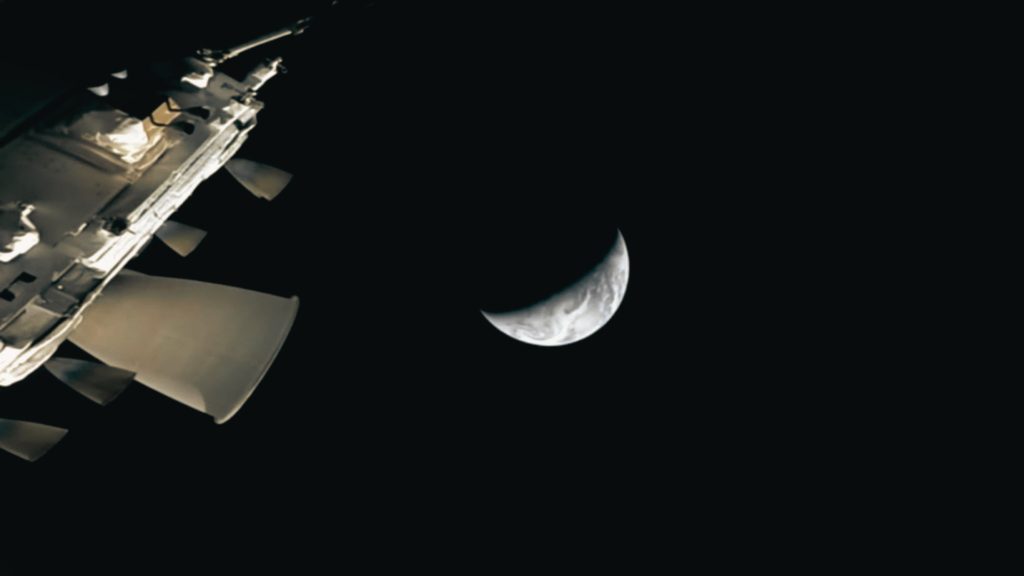
The climax of the Artemis II mission occurred during the lunar flyby. As Orion approached the Moon, it utilized lunar gravity to slingshot around the celestial body. The spacecraft passed within a few thousand miles of the lunar surface, providing the crew with an unprecedented, high-definition view of the cratered landscape.
As Orion traveled behind the far side of the Moon, it entered a communications blackout period with Earth—a tense but expected phase of the mission. For nearly 45 minutes, the crew was entirely isolated, relying solely on Orion’s automated systems and their own extensive training. When the spacecraft re-emerged and re-established contact with NASA’s Deep Space Network, cheers erupted in Mission Control in Houston.
It was during this phase that the crew captured stunning new images of the lunar surface and recreated the iconic “Earthrise” photograph, showing our fragile blue marble suspended against the vast, dark emptiness of space. These images have already begun circulating globally, serving as a powerful reminder of humanity’s shared home and our boundless curiosity.
The Road to Artemis III and the Lunar South Pole
With the successful completion of the lunar flyby, the data collected during Artemis II will be meticulously analyzed to ensure maximum safety and efficiency for the next phase of the program. Artemis III, the highly anticipated follow-up mission, will take the ultimate step of landing humans on the lunar surface.
Artemis III aims to target the Moon’s rugged South Pole, a region of immense scientific interest due to the confirmed presence of permanently shadowed craters containing water ice. This water ice is a game-changer for space exploration; it can be mined and processed into drinking water, breathable oxygen, and most importantly, rocket fuel. By utilizing the Moon’s local resources (in-situ resource utilization), NASA and its partners can dramatically reduce the cost and complexity of future missions.
Building a Sustainable Space Economy
The Artemis program is not merely about planting flags and leaving footprints; it is about establishing a sustainable, long-term human presence in deep space. The technologies developed and tested during Artemis II are already stimulating a booming global space economy. From private aerospace companies developing new lunar landers and commercial spacesuits to startups focusing on space agriculture and advanced robotics, the commercial sector is deeply intertwined with government exploration goals.
Furthermore, the scientific experiments conducted onboard Orion will yield insights into how the human body reacts to deep space radiation and microgravity, crucial data for protecting astronauts on longer journeys. The innovations sparked by this mission will inevitably trickle down to benefit life on Earth, driving advancements in materials science, medical diagnostics, and telecommunications.
Looking Forward: The Ultimate Goal of Mars
As the Artemis II crew prepares for their high-speed reentry into Earth’s atmosphere and a splashdown in the Pacific Ocean, the success of this mission echoes far beyond the Moon. The Moon is the proving ground. Everything NASA and its international partners learn about living, working, and operating spacecraft in the harsh lunar environment will directly inform the ultimate goal: sending the first human expedition to Mars.
Artemis II has proven that the hardware is ready, the international partnerships are strong, and the human spirit of exploration remains as bold as ever. As we look up at the night sky, the Moon no longer seems like a distant, unreachable satellite, but rather the next stepping stone in humanity’s grand journey into the cosmos.