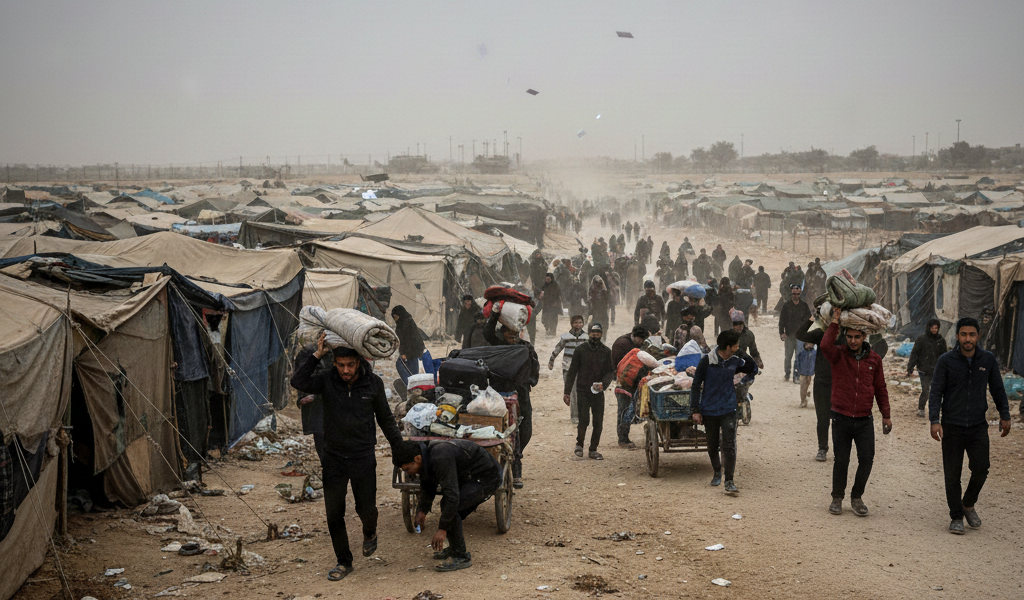
On Jan. 20, 2026, Israeli forces dropped leaflets ordering dozens of Palestinian families in southern Gaza to evacuate their homes – the first such forced displacement since last October’s ceasefire. The warning, delivered in Arabic, Hebrew and English over a tent camp east of Khan Younis, signaled a widening of Israel’s ground control in Gaza. Below are the key developments in this unfolding story:
Key Developments
- Evacuation order via leaflets: Israeli troops dropped leaflets over the Al-Reqeb tent encampment in Bani Suhaila, east of Khan Younis, warning residents that “the area is under IDF control” and they “must evacuate immediately”.
- Targeted area: The evacuation order specifically affected tent communities in Bani Suhaila. Residents reported the leaflets were delivered on Monday morning, instructing families to leave the sector.
- Displacement scale: Gaza’s Hamas-run government said Israel has expanded its buffer zone five times since the ceasefire, uprooting roughly 9,000 people in total. It added that the latest order directly affected about 3,000 people (around 70 families) in Bani Suhaila.
- Israeli statement: An Israeli military spokesman told reporters the leaflet drops were meant only as warnings – to keep Palestinians from crossing the ceasefire line – and denied any plan to permanently displace civilians.
Evacuation Orders in Gaza
Israeli forces announced the evacuation by dropping leaflets from the air into the refugee-style encampments. One leaflet — printed in Arabic, Hebrew and English — carried an “urgent message” warning Gazans that the sector had come under Israeli military control. According to Reuters, residents of the Al-Reqeb neighborhood immediately abandoned their damaged tents and temporary shelters, scrambling to areas west of the advance. Military officials said the drop was a precautionary measure and insisted there was no directive to expel residents beyond the instructions to stay clear of the newly occupied zone. Nonetheless, the mandatory evacuation notice marked a stark escalation: it was “the first forced evacuation since October’s ceasefire,” as locals noted.
Humanitarian Impact and Reactions
Hamas-run Gaza authorities strongly condemned the evacuation order. Ismail Al‑Thawabta, director of the Gaza government’s media office, said Israeli forces had already expanded their foothold in eastern Khan Younis five times since the ceasefire, displacing about 9,000 Gazans so far. He reported that Monday’s leaflet demand directly affected roughly 3,000 people (around 70 families) and described the move as part of “a policy of intimidation and pressure on civilians”. Thawabta warned that the action created “a state of humanitarian disruption,” further straining the limited shelter and aid resources in the area.
Displaced residents gave harrowing first-hand accounts. One tent camp father, identified only as Mahmoud, said he and his neighbors were among those forced to move. “We have fled the area and relocated westward,” he told Reuters, noting that his family had already been uprooted “the fourth or fifth time” in recent weeks as Israel shifted the ceasefire “yellow line” deeper into Gaza. He said each expansion pushed Israeli control roughly 120–150 meters further into the Palestinian territory, “swallowing more land” and sending dozens of families running for their lives.
Gaza Ceasefire and Ongoing Crisis
Analysts say the evacuation highlights how fragile Gaza’s truce remains. The U.S.-brokered October 2025 ceasefire ended active fighting, but Gaza is still deeply divided and destabilized. Under the agreement’s first phase, Israel withdrew from some areas while roughly two million Palestinians remain confined to the southern third of the territory, largely in makeshift camps. Implementation of the ceasefire’s later phases – including Hamas disarmament and further Israeli pullback – has stalled amid mutual recriminations. Since the truce took effect, Gaza’s health authorities report more than 460 Palestinians killed (and three Israeli soldiers) in the tense stand-down. Overall, Palestinian officials say the 2023–25 conflict left roughly 71,000 Gazans dead, while Israel counts about 1,200 of its citizens killed in the initial Hamas attacks of October 2023.
The forced evacuation order has drawn international concern, with aid agencies warning that repeated displacements and shrinking safe zones only deepen the humanitarian crisis for Gaza’s civilian population.